IGF-1 DES
Showing the single result
-
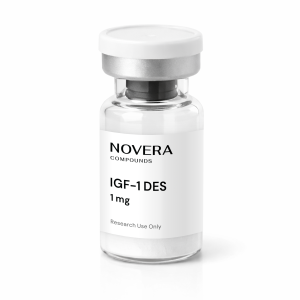

IGF-1 DES 1mg
Read MoreIGF-1 DES is a 67-amino-acid truncated analog of insulin-like growth factor-1, engineered with reduced binding affinity to IGF binding proteins, producing potent localized anabolic activity at the injection site. Sports medicine physicians, anti-aging clinicians, and compounding pharmacists evaluating site-specific muscle growth and tissue repair protocols will find purity documentation, storage guidance, and sourcing support through the Direct Doctor Supply support team. The guide below reviews its mechanism, clinical rationale, dosing considerations, safety profile, and key comparisons with related compounds.
What Is IGF-1 DES? 67 Amino Acids & Reduced Binding Affinity
IGF-1 DES is a 67-amino-acid truncated form of insulin-like growth factor-1 created by removing the N-terminal tripeptide from native IGF-1. This structural modification reduces binding to IGF-binding proteins (IGFBPs), and preclinical evidence indicates that this truncated analog is more potent than native IGF-1 in bioassay models. [1] [2] The reduced IGFBP interaction results in less plasma sequestration, allowing more active peptide to remain concentrated near the injection site and contributing to its localized anabolic profile. [1] It is a research compound and is not FDA-approved.
Within the muscle growth and performance peptide category, the defining characteristic of IGF-1 DES is its site-specific anabolic activity rather than broad systemic distribution. Unlike growth hormone secretagogues, which act through the endocrine axis, IGF-1 DES interacts directly with IGF-1 receptors in target tissues. [4] Native insulin-like growth factor-1 is rapidly bound by circulating proteins that regulate its distribution and activity; the truncation that defines IGF-1 DES reduces this interaction, leaving a greater proportion of bioactive peptide available locally. [1]
Research suggests the peptide has a half-life of approximately 20-30 minutes. While this limits systemic exposure, it may increase local receptor activation during the immediate post-administration period. After receptor binding, intracellular pathways, including PI3K/Akt/mTOR and MEK/ERK, are activated, contributing to protein synthesis and anabolic signaling. [3] Evidence supporting these mechanisms in the context of IGF-1 DES specifically is largely extrapolated from IGF-1 biology and preclinical investigations rather than large-scale human clinical trials.
IGF-1 DES vs LR3: Difference Between IGF-1 LR3 and IGF DES
The IGF-1 DES vs. LR3 comparison is one of the most common in research peptide discussions, and the difference between IGF-1 LR3 and IGF DES begins with their pharmacokinetic profiles.
IGF-1 LR3 was engineered to resist binding by IGFBPs and maintain circulation for substantially longer periods. Practitioner discussions commonly cite approximately 13 times the half-life of standard IGF-1, though this figure is practitioner-reported, and a dedicated LR3 peer-reviewed source should be consulted to verify this claim. This prolonged exposure leads to systemic distribution and broader anabolic activity across multiple tissues, making LR3 more relevant when generalized anabolic support, recovery enhancement, or body composition goals are the primary objectives.
IGF-1 DES follows a different model. Its rapid clearance and reduced IGFBP binding result in a highly localized effect concentrated near the injection site, with preclinical evidence indicating greater potency than native IGF-1 in direct tissue bioassays. [1] [2] Practitioners discussing site-specific anabolic stimulation often view this short duration of activity as an advantage, as it limits prolonged systemic exposure while directing activity toward a specific muscle group.
Some practitioners report using the two compounds at different phases of a research protocol, with DES associated with focused local interventions and LR3 used as a systemic anabolic agent. Evidence supporting specific protocol structures remains limited, and individualized assessment is required before extrapolating research findings to clinical practice.
How to Inject IGF-1 DES: Dosage & Protocol
Unlike many peptides administered subcutaneously, the primary rationale for IGF-1 DES administration is intramuscular delivery into the target muscle, reflecting its localized mechanism of action.
Practitioner-reported protocols commonly reference doses of 20-100 mcg per injection site. These figures originate from research-use references and anecdotal practitioner experience rather than FDA-validated clinical protocols, and all dosing should be considered exploratory and require individualized clinical assessment.
Timing is frequently emphasized, given the peptide’s short half-life. Some practitioners report administering IGF-1 DES immediately after resistance exercise to align receptor activation with exercise-induced satellite cell recruitment, thereby maximizing local anabolic signaling during a period of heightened tissue responsiveness. Administration frequency varies; research discussions commonly reference once-daily or several-times-weekly injections, depending on protocol objectives.
Reconstitute with bacteriostatic water per the supplier’s handling instructions. Post-reconstitution, store at 2-8°C, protect from light, and use promptly to preserve peptide integrity. When buying online, practitioners should review the supplier’s lot-specific certificate of analysis and cold-chain handling documentation as part of standard quality verification.
IGF-1 DES Benefits, Side Effects & Legal Status
The primary application associated with IGF-1 DES is localized hypertrophy. Preclinical evidence and mechanistic studies suggest that the truncated analog activates IGF-1 receptors with greater potency than native IGF-1, thereby contributing to satellite cell activation and protein synthesis in tissues at the injection site. [2] These findings are preclinical and mechanistic in nature; large-scale human clinical evidence is currently lacking.
Tissue repair and exercise recovery represent secondary areas of investigation. Early-stage research suggests IGF-1 signaling may contribute to regeneration processes following muscular stress or injury, though human clinical evidence remains limited. [4]
Fat oxidation is occasionally discussed within the broader IGF-1 literature, but should be considered a tertiary area of interest. Evidence supporting meaningful fat loss is substantially weaker than evidence for localized muscle growth and should not be cited as a primary clinical rationale.
Side Effects and Safety Considerations
Available safety data for IGF-1 DES remain limited, with most information derived from mechanistic research, preclinical studies, and practitioner-reported experience.
- Hypoglycemia risk: IGF-1 receptors share signaling characteristics with insulin pathways, and IGF-1 signaling has been shown to affect glucose metabolism. [4] Blood glucose monitoring is commonly recommended, particularly when administration occurs in a fasted state or during or after exercise.
- Injection-site reactions: Mild redness, irritation, swelling, or discomfort may occur and are not considered unique to IGF-1 DES.
- Localized tissue overgrowth: Prolonged exposure to high-dose anabolic signaling may theoretically increase the risk of excessive tissue growth at the injection site. Direct evidence is limited, but this concern is commonly discussed in relation to chronic high-dose use.
- Limited long-term safety data: Robust long-term human studies are currently lacking. The overall safety profile remains incompletely characterized.
Current Regulatory Status
- United States: IGF-1 DES is not FDA-approved and is not included on the FDA 503A compounding list. It is classified as a research compound. Verify current regulatory guidance before considering any protocol.
- Australia: IGF-1 DES is not approved by the Therapeutic Goods Administration for routine clinical use. Confirm current status using government resources.
- WADA: The World Anti-Doping Agency classifies IGF-1 and related analogs as prohibited substances under S2 (Peptide Hormones, Growth Factors, Related Substances and Mimetics). [5] Athletes must verify current anti-doping rules before use.
IGF-1 DES vs CJC-1295, Ipamorelin & Sermorelin
Although these peptides are often discussed within similar performance and anti-aging contexts, they influence different biological pathways. Comparing their mechanisms helps clarify appropriate research applications and protocol objectives.
IGF-1 DES vs CJC-1295
CJC-1295 and IGF-1 DES target different points within the growth hormone axis. IGF-1 DES acts directly at the IGF-1 receptor level within target tissues, bypassing upstream endocrine regulation entirely. CJC-1295, as a GHRH analog, stimulates endogenous growth hormone release, which may subsequently increase systemic IGF-1 levels. Practitioners generally consider CJC-1295 when broader growth hormone optimization and body composition support are the primary objectives, while IGF-1 DES is more relevant when site-specific anabolic receptor-level activity is the goal.
IGF-1 DES vs Ipamorelin
Ipamorelin stimulates pulsatile growth hormone release by selectively activating the ghrelin receptor and does not directly activate IGF-1 receptors. IGF-1 DES acts downstream, interacting directly with target tissue receptors. Because they act through distinct mechanisms at different levels of the axis, some practitioners describe them as complementary: Ipamorelin supports systemic endocrine signaling, while IGF-1 DES delivers localized anabolic stimulation at the receptor level.
IGF-1 DES vs Sermorelin
Sermorelin promotes growth hormone release through physiological stimulation of the pituitary gland, maintaining the natural GH/IGF-1 axis and representing a conservative approach to supporting systemic hormone regulation. IGF-1 DES bypasses the pituitary entirely and delivers receptor-level activity directly within target tissues. Practitioners may consider Sermorelin when physiological GH-axis support with maintained pulsatility is the goal, and IGF-1 DES when localized muscle anabolism at the receptor level is the primary research objective.
Taken together, secretagogues such as CJC-1295, Ipamorelin, and Sermorelin influence upstream endocrine pathways, while IGF-1 DES functions as a direct receptor-level anabolic agent. The distinction depends on whether systemic hormonal modulation or localized tissue-specific activity is the primary research objective.
How Can Practitioners Source or Buy IGF-1 DES for Research?
Research-grade IGF-1 DES is available only to qualified, licensed medical professionals. When evaluating suppliers, practitioners should confirm:
- Certificates of analysis (CoA) with batch-specific purity data
- LOT number traceability
- Independent third-party purity verification
- Cold-chain handling documentation and post-reconstitution stability data
Direct Doctor Supply provides sourcing guidance and documentation support to help licensed practitioners identify verified research-grade suppliers. Those looking to buy IGF-1 DES online or explore wholesale purchasing options are encouraged to contact the Direct Doctor Supply support team for sourcing direction. Practitioners who want to check for wholesale buying options or need to buy IGF-1 DES wholesale can reach the support team directly for supplier guidance.
FAQs
1. What is IGF-1 DES?
IGF-1 DES is a 67-amino-acid truncated IGF-1 analog created by deletion of the N-terminal tripeptide, which reduces its binding to IGF binding proteins and increases local tissue bioavailability. [1] Preclinical evidence indicates that it is more potent than native IGF-1 in direct bioassay models. [2] It is investigated primarily for localized anabolic effects related to muscle growth and tissue repair. IGF-1 DES is a research compound and is not FDA-approved.
2. What is the difference between IGF-1 DES and LR3?
IGF-1 DES has a short half-life of approximately 20-30 minutes and is associated with localized anabolic activity at the injection site, making it relevant for targeted muscle hypertrophy. IGF-1 LR3 demonstrates significantly longer systemic exposure and broader anabolic distribution throughout the body, making it more appropriate for generalized anabolic support and body composition objectives. The two compounds differ primarily in half-life, distribution profile, and site-specificity of action.
3. How do you inject IGF-1 DES?
Practitioner-reported protocols reference intramuscular injection into the target muscle rather than subcutaneous administration. Research doses commonly discussed range from 20-100 mcg per site, often administered post-exercise. Reconstitution uses bacteriostatic water, with post-reconstitution storage at 2-8°C. No FDA-validated dosing protocol currently exists; all dosing is practitioner-reported and requires individualized clinical assessment.
4. What are the IGF-1 DES side effects?
Potential side effects include hypoglycemia (due to insulin-like IGF-1 receptor signaling; blood glucose monitoring is recommended [4]), injection-site reactions, and a theoretical risk of localized tissue overgrowth with chronic high-dose use. Long-term human safety data remain limited, and the overall safety profile is not fully characterized.
5. Is IGF-1 DES legal and WADA-prohibited?
IGF-1 DES is not FDA- or TGA-approved for routine clinical use and is classified as a research compound. It is not on the FDA 503A compounding list. The World Anti-Doping Agency prohibits IGF-1 and related analogs under S2, and athletes should verify current anti-doping rules before use. [5] Regulatory status should be independently verified, as policies are subject to change.
Sources
- Ballard FJ, Francis GL, Ross M, Bagley CJ, May B, Wallace JC. Natural and synthetic forms of insulin-like growth factor-1 (IGF-1) and the potent derivative, destripeptide IGF-1: biological activities and receptor binding. Biochem Biophys Res Commun. 1987;149(2):398-404. doi:1016/0006-291x(87)90380-9
- Cascieri MA, Chicchi GG, Applebaum J, Hayes NS, Green BG, Bayne ML. Mutants of human insulin-like growth factor I with reduced affinity for the type 1 insulin-like growth factor receptor. Biochemistry. 1988;27(9):3229-3233. doi:10.1021/bi00409a016
- Bibollet-Bahena O, Almazan G. IGF-1-stimulated protein synthesis in oligodendrocyte progenitors requires PI3K/mTOR/Akt and MEK/ERK pathways. J Neurochem. 2009;109(5):1440-1451. doi:10.1111/j.1471-4159.2009.06071.x
- Frystyk J. Free insulin-like growth factors — measurements and relationships to growth hormone secretion and glucose homeostasis. Growth Horm IGF Res. 2004;14(5):337-375. doi:10.1016/j.ghir.2004.06.001
- World Anti-Doping Agency. The Prohibited List. https://www.wada-ama.org/en/prohibited-list
For licensed medical professionals only. This content is for informational purposes only and does not constitute medical advice.
Content prepared by Direct Doctor Supply’s editorial team.
Sourcing and accuracy for this page follow our Editorial Policy: claims are cross-checked against clinical literature, regulatory filings, and manufacturer specifications before anything is published.